

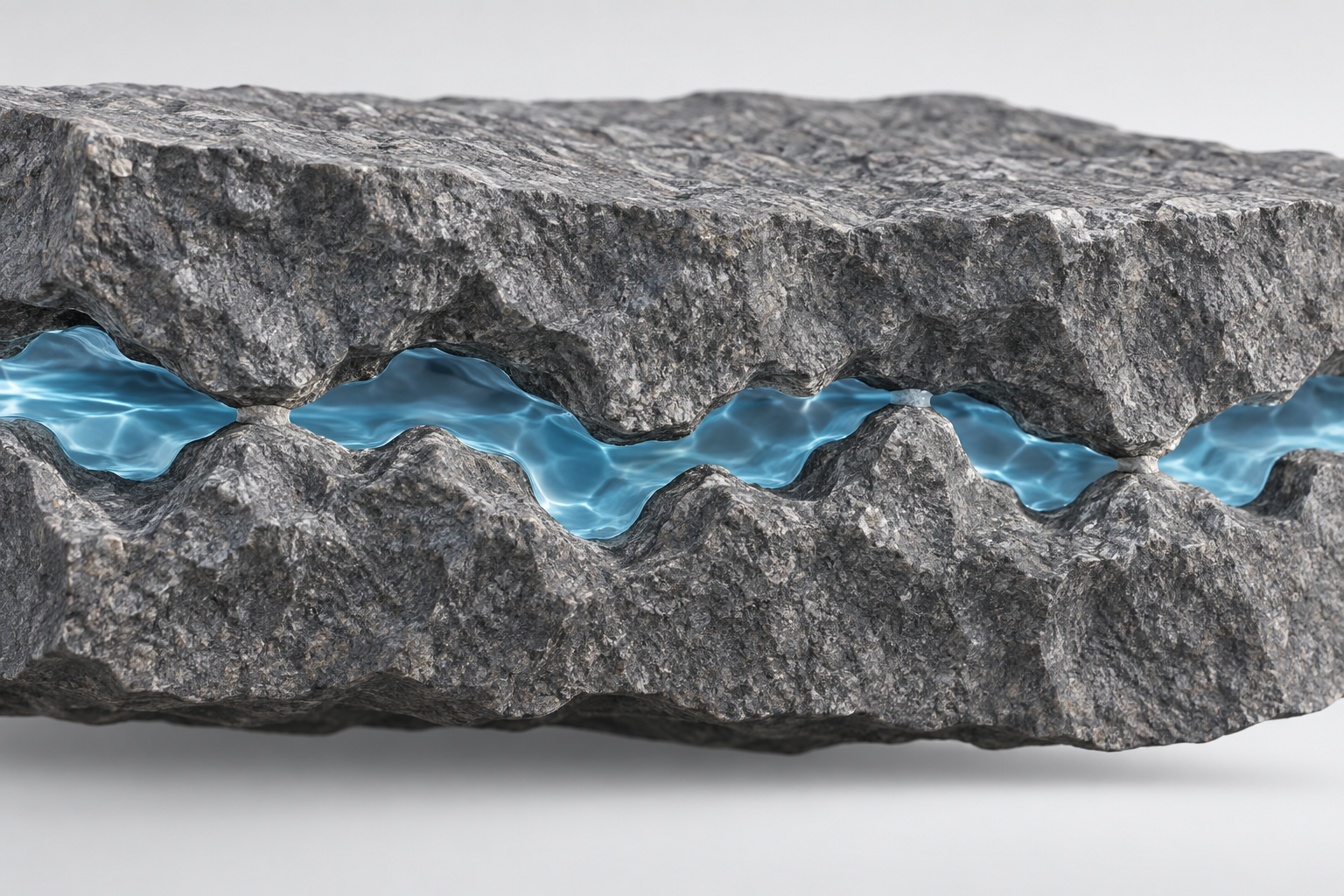
A rough fracture is a network of contacts and openings rather than a uniform water channel. This note explains how experiments on shaped Carrara marble surfaces were connected to a normal-contact calculation and a separate hydraulic model. The mechanical stage supplied the spatial aperture field needed to estimate flow. Surface matching and applied stress strongly affected the comparison with measured transmissivity, while shear experiments showed why sliding cannot automatically be assumed to improve transport. The article distinguishes the solver contribution from surface generation, hydraulic calculations and geological interpretation. It also explains the limits of transferring this laboratory workflow to other rocks or to full geothermal reservoirs.
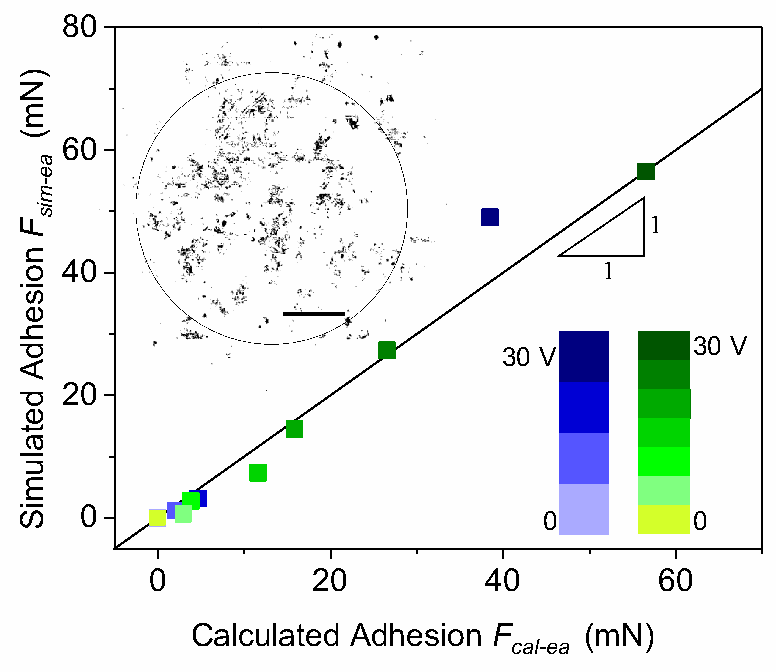
Electrical attraction between rough surfaces depends strongly on the smallest gaps around their contact patches. This note explains how a silicon-contact study combined a TriboSolver mechanical gap field with a separate dielectric model and friction measurements. It sets out the external and repulsive loading conventions, the fitted oxide thickness and the integration of electrical pressure over noncontact regions. Particular attention is given to the difference between force in millinewtons and pressure normalized over a microscopic area. The article also explains why the simple model cannot reproduce the observed polarity asymmetry and why the published experiment is not, by itself, verification of a current software release.