
Humidity and Friction: Why Smoother Surfaces Can Stick More
Why polishing does not answer every friction problem
A smoother surface is not automatically a lower-friction surface. Before specifying a finish, it is worth asking what occupies the space between the two bodies: air, adsorbed moisture, a lubricant, or a combination of these.
The important distinction is between solid contact and near contact. Two points can be close enough for an intervening liquid to matter without the solids actually touching.
The research question
Hsia and colleagues investigated how roughness affected friction at silicon-nitride–sapphire interfaces. Their 2021 study found that smoother surfaces could show higher friction because of capillary adhesion. Contact-area changes alone did not explain the friction trend. Read the primary study.
Where Tribology Simulator was used
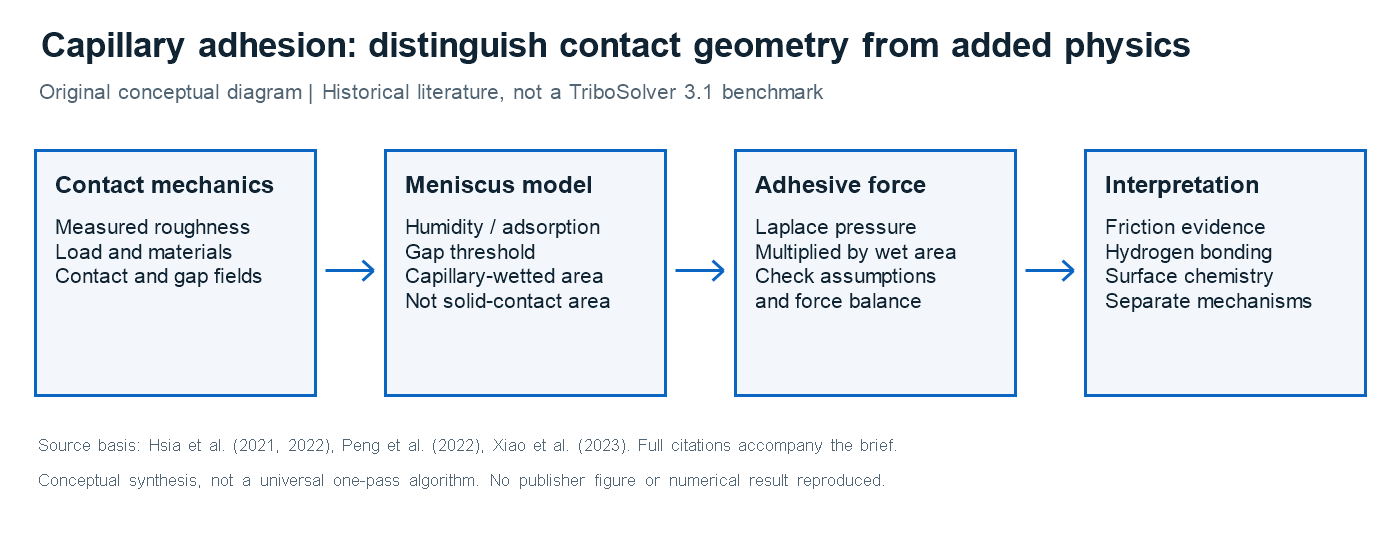
The study combined measured surface topography with elastic–plastic contact calculations using Tribology Simulator. The calculation described solid contact and the remaining gaps. A separate capillary model used the gap geometry to estimate where liquid bridges could form and how they contributed to adhesion.
Consequently, the wetted area was not interchangeable with the real solid-contact area. Nor was the contact solver, by itself, a complete humidity-to-friction model. The interpretation depended on the studied materials, surface condition and condensation assumptions.
Why this distinction is useful
Imagine comparing two finishes that have similar load capacity but different distributions of small gaps. A single roughness value cannot show where those gaps occur. A spatial calculation gives a more useful starting point for asking whether the environment could change the behaviour.
For your own comparison, keep three sets of information separate:
- Geometry and mechanics: topography, load and material properties.
- Environment: humidity, temperature and surface preparation.
- Additional physics: the adhesion or liquid-bridge model and its assumptions.
This makes it easier to identify which change actually explains a result.
Reading the results without overgeneralising
The practical lesson is to investigate the mechanism before assuming that “smoother” means “better.” It is not a recommendation to roughen every component. Wear, sealing and other performance requirements may favour a different finish.
This article describes an earlier research workflow, not a universal performance claim for the current TriboSolver release. View access options or ask about your application.