

Interfacial Shear Strength: How Contact Area Helps Explain Lubrication
Does lower friction mean less contact, or an easier-to-shear interface?
A lubricant can reduce friction without visibly separating two objects. At low speeds, a few adsorbed molecular layers may remain between contacting asperities even when there is no substantial fluid film carrying the load. Explaining the reduction requires more than measuring the total friction force.
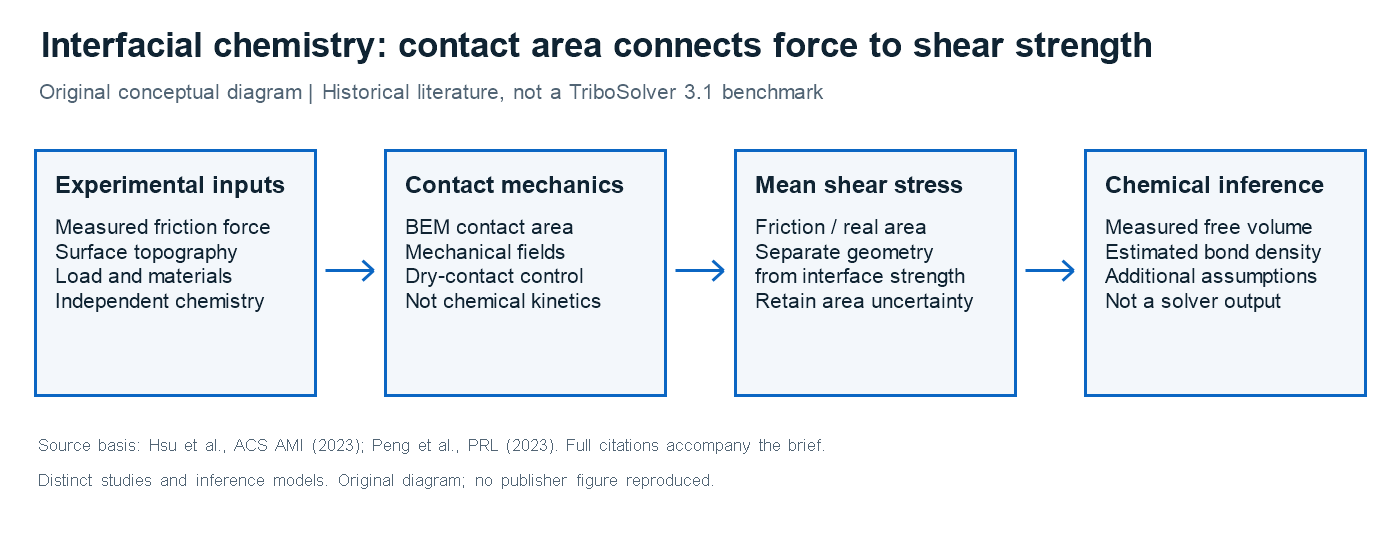
Two possibilities must be distinguished. The solids may touch over a smaller real area, or the material within that area may resist shear less strongly. Dividing friction force by real contact area gives a mean interfacial shear stress. That quantity helps separate a geometric change from a change in the local behavior of the interface.
A 2023 study by Hsu and colleagues used this reasoning to investigate vapor-phase lubrication of a polypropylene bead against glass. Fluorescence measurements revealed contact and molecular mobility, while TriboSolver supplied a dry mechanical-contact comparison. A separate molecular-scale interpretation connected the optical measurements with the dependence of friction on sliding speed.
The investigated system
The main contact used a 3 mm diameter polypropylene bead pressed onto glass. Polypropylene was selected for its resistance to alcohol. A rheometer controlled force and sliding, and the glass carried covalently attached fluorescent probe molecules whose response depended on their local molecular freedom.
The baseline Figure 1 experiments used 45 mN normal force and 0.25 µm/s sliding speed. A small chamber received either dry nitrogen or nitrogen containing 2-propanol vapor. Dry conditions had relative humidity below 0.8%. Mixing saturated vapor with dry gas varied the alcohol partial pressure; the stated environment was applied for 40 minutes before the friction measurements.
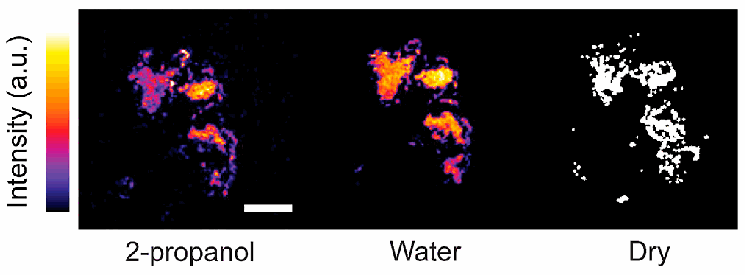
A separate area-control experiment immersed the contact in liquid water or liquid 2-propanol so that fluorescence images could reveal the real contact area. The authors compared these measured areas with a dry-contact calculation. These liquid-immersion images are not two vapor-condition simulations, and the distinction matters when interpreting the published result.
Why contact area was needed
In the vapor experiments, saturated 2-propanol reduced friction to about 60% of its dry-nitrogen value. That observation alone does not identify the cause. If the contact area also fell by a similar fraction, a geometric explanation could be plausible. If area remained almost unchanged, attention should turn to the shear response of the contacting interface.
The fluorescence probe helped identify loaded regions because its excited-state motion became constrained in contact. The researchers used intensity thresholding to estimate area and fluorescence lifetime to examine molecular mobility. Those are experimental measurements. The mechanical calculation supplied a reference area for the dry interface rather than predicting the optical or chemical response.
How TriboSolver was used
The paper explicitly names TriboSolver and cites its Tribology.eu home page in reference 43. It describes an elastic–fully-plastic boundary element method using a half-space approximation. Figure 2 includes the resulting dry-contact pattern beside fluorescence images of the liquid-lubricated contacts.
| Model element | Information used in the study |
|---|---|
| Contact bodies | Polypropylene bead and glass counterface; optical experiments used a surface-bound DCDHF probe. |
| Geometry | Bead-on-flat configuration; experimental bead diameter 3 mm. |
| Normal load | 45 mN for the Figure 2 comparison. |
| Surface input | Bead topography; before/after experimental topography is reported in Figure S2. Exact numerical surface arrays and sampling remain unverified here. |
| Material properties | Assigned by the paper to the supporting-information input table. The file could not be retrieved during this review; no guessed polymer properties are inserted. |
| Contact model | Elastic–fully-plastic BEM half-space approximation, explicitly stated in the main text. |
| Main TriboSolver outputs | Dry mechanical contact pattern and real contact area used as a comparison for optical measurements. |
| Downstream calculation | Measured friction divided by area for mean shear stress; fluorescence-lifetime analysis and an Eyring-type interpretation performed separately. |
Missing supporting parameters limit reconstruction, not the ability to explain the reported workflow. The final grid, material values, convergence settings and historical software build must be verified before claiming an exact rerun. This note does not substitute current defaults for the original authors’ inputs.
From contact area to a molecular interpretation
The reasoning begins with an area check. Figure 2 reports approximately 4000 µm² real contact area and about 11 MPa mean contact pressure at 45 mN. Areas from liquid-lubricated imaging and the dry BEM comparison differed by less than 5%. That is a comparison for this experimental system, not a general accuracy specification for the software.
With broadly similar areas, different friction forces imply different mean shear stresses. The reported values were 2.3 MPa in liquid 2-propanol, 4.1 MPa in water and 3.4 MPa for the dry comparison. The calculation helped establish that a large area change was not required to explain the observed differences.
The researchers then investigated the vapor-lubricated interface separately. Increasing alcohol partial pressure reduced the probe’s fluorescence lifetime, indicating greater molecular mobility or free volume in its environment. Mean shear stress also decreased. Friction experiments across sliding speeds of 0.25–25 µm/s supplied an additional way to test the interpretation.
An Eyring-type model connects the rate of a thermally activated shear process with applied stress. In this study, the stress activation volume represented the volume of boundary-layer molecules involved in that process. It was inferred from the velocity dependence and compared with the optical free-volume measure. Neither quantity was an output of the BEM contact calculation.
Main findings and their meaning
The authors found that the velocity-derived activation volume correlated with the fluorescence-derived free-volume measure. The combined analysis supported a picture in which larger groups of mobile alcohol molecules participate in shear as vapor concentration rises, lowering the required stress. They estimated characteristic cluster volumes of roughly 20–30 nm³ for their system.
The paper used a reference velocity of 60 m/s and an effective activation energy of approximately 10−19 J, or 0.6 eV, when combining the friction data. These parameters belong to the molecular interpretation. Their successful use does not mean that contact area alone determines chemistry or that the same parameter values apply to another lubricant.
What TriboSolver contributed—and what it did not
TriboSolver contributed: a dry mechanical-contact comparison that helped distinguish area changes from changes in interfacial shear response.
Additional author methods: controlled-atmosphere friction tests, optical contact measurement, fluorescence lifetime and Eyring analysis.
Not demonstrated: simulation of alcohol adsorption, molecular clusters or bond kinetics by the contact solver; a universal less-than-5% error bound; or a current-release reproduction.
Mean shear stress is still an average. It does not resolve the traction at every asperity or prove that all molecular regions shear identically. Optical resolution, the selected probe, surface chemistry and possible changes in topography remain part of the interpretation. The authors checked before/after bead topography and did not find severe wear or deformation in the reported comparison.
Practical applications and conclusion
This separation of geometry and interfacial response could help investigations of boundary lubrication, low-speed positioning or micro-scale contacts. A useful experiment measures both force and contact area, then adds chemistry-sensitive evidence before attributing a friction change to molecular behavior. Such extensions require their own material compatibility and environmental controls.
The study illustrates a limited but important role for contact mechanics: supplying the denominator and a geometric control. TriboSolver did not independently explain every molecular process. Its contact comparison, combined with optical and friction measurements, helped the authors show why a boundary layer could reduce shear resistance without substantially reducing real contact area.
Reference and software links
Chao-Chun Hsu, Liang Peng, Feng-Chun Hsia, Bart Weber, Daniel Bonn and Albert M. Brouwer. “Molecular Probing of the Stress Activation Volume in Vapor Phase Lubricated Friction.” ACS Applied Materials & Interfaces 15, 12603–12608 (2023). Canonical publication · Open-access published paper.
Explore TriboSolver or discuss your application. The related optical-contact note explains why area comparison and pressure calibration should also remain separate.