
Ceramic Surface Roughness: Linking Contact Pressure and Wear
Choosing a ceramic finish starts with the contact
A roughness value is a convenient manufacturing specification, but it is not a complete description of an interface. For a ceramic component, a more informative question is where the load is carried when that surface meets its counterface.
Contact analysis can help answer that question. Friction and wear measurements are still needed to establish how the interface behaves during sliding.
The research application
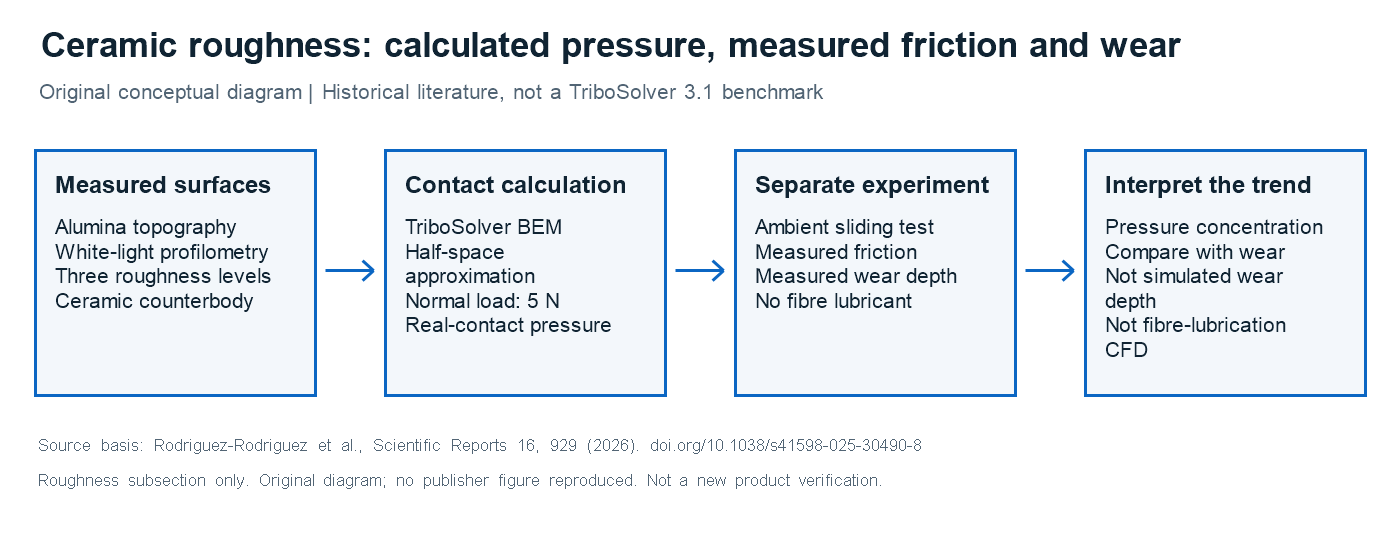
Rodriguez-Rodriguez and colleagues studied ceramic–glass friction in research on cellulosic fibres. Within that wider study, a separate roughness investigation examined ceramic contacts without the fibre or polymer additives. TriboSolver used measured surface topography to calculate contact pressure. Read the Scientific Reports paper.
In the reported roughness comparison, Ra values of 1.00, 2.20 and 3.00 µm corresponded to calculated pressures of 594, 767 and 829 MPa. Friction and wear-track depth were measured experimentally, not predicted by that pressure calculation.
Why that separation matters
The simulation helped interpret the mechanical contact. It did not simulate the complete fibre-lubrication mechanism or independently calculate all observed wear.
The published title describes a broader investigation than the solver’s specific contribution. Keeping that distinction clear prevents a useful contact-pressure result from being turned into an unsupported claim about lubricant performance.
Using the idea in a surface-finish comparison
A practical study can begin with several measured finishes, a common counterface and consistent loading. Compare the contact patterns and pressure distributions before deciding what additional experiment is needed.
Keep the following alongside each result:
- The measured surface map and its resolution.
- The material and loading assumptions.
- The definition of any reported pressure statistic.
- The separately measured friction and wear outcomes.
This is more informative than ranking finishes using a roughness number alone. It also makes clear which conclusions come from calculation and which come from testing.
The lesson for TriboSolver users
The study illustrates how numerical contact analysis can support the interpretation of ceramic experiments. It does not make calculated pressure a universal wear law, and it is not a release-specific verification certificate.
Discuss your ceramic contact problem or review TriboSolver access options.