
Why Is Ice Slippery? Roughness, Pressure and Contact Mechanics
A familiar surface with an unfamiliar friction problem
Ice can feel remarkably slippery, yet a rough object can drag or scrape across it. For engineers, the useful question is not simply whether ice has a low friction coefficient. It is which conditions make sliding easy—and which turn the same interface into a high-resistance contact.
A friction coefficient describes the measured ratio of tangential force to normal load. It does not, by itself, identify the mechanism responsible. Surface shape, deformation and operating conditions need to be considered together.
What the research investigated
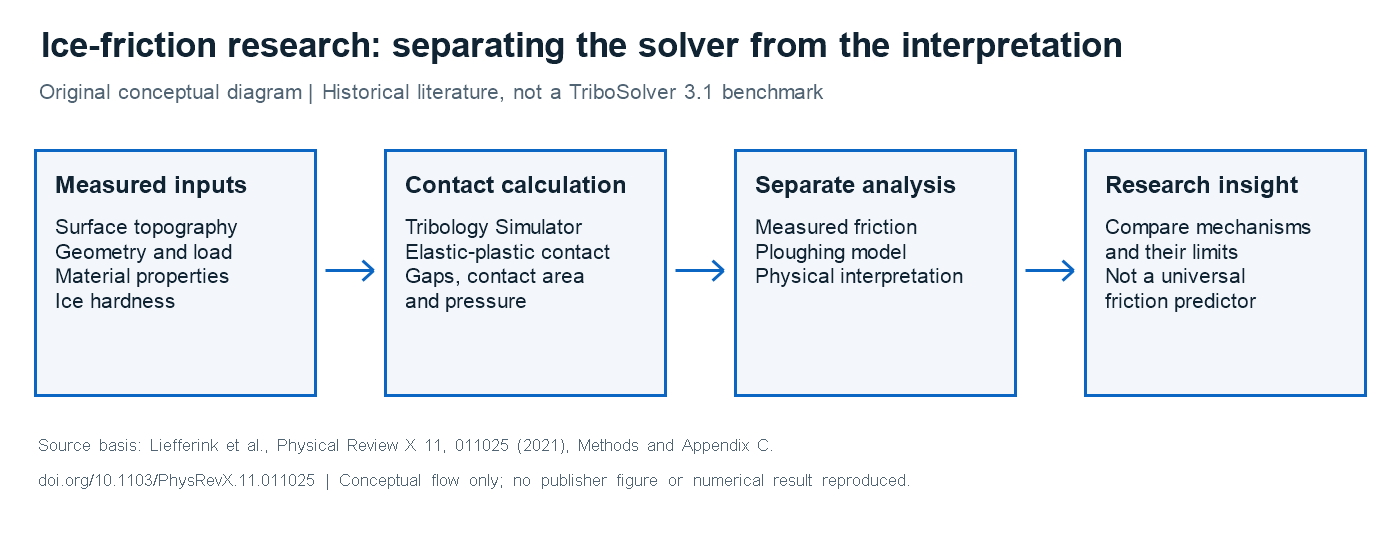
Liefferink and colleagues studied sphere-on-ice friction while varying temperature, contact pressure and speed. Their results connected colder-condition friction to thermally activated surface processes and highlighted plastic deformation and ploughing closer to melting. The paper does not reduce ice friction to one universal mechanism. Read the study in Physical Review X.
How Tribology Simulator contributed
The researchers used Tribology Simulator, the historical software name stated in the paper, to solve elastic–plastic contact using slider topography and material properties. This supplied the mechanical picture: how the surfaces meet and how pressure is distributed.
That distinction matters. The contact calculation was part of the explanation of the experiments; it was not a stand-alone prediction of every temperature- and speed-dependent friction process. The paper’s friction interpretation also relied on experimental evidence.
Turning the research into a useful modelling question
For a new ice-contact problem, begin with the question you need to answer. Are you comparing surface finishes, estimating concentrated loading, or interpreting a change in measured friction?
Keep the measured sliding conditions alongside the model inputs. Record the height-map dimensions and units, the load, and the material assumptions. When comparing two surfaces, change one input at a time. A pressure map can then help explain a difference without being mistaken for a complete friction law.
What this means for TriboSolver users
This study illustrates why realistic topography is valuable in contact analysis. It is a historical research application, not proof that a present-day release reproduces the experiment automatically. Reproduction requires the original inputs and the additional physical assumptions used by the authors.
Explore TriboSolver access options or discuss your contact problem.